
Home / Reptiles / Lizards / Chamaeleonidae / Werner's chameleon
Some federal rules applyWerner's chameleon
Trioceros werneri
Reptiles › Lizards (Lacertilia) › Chamaeleonidae (Chameleons)
Trioceros werneri, the Wemer's chameleon or Wemer's three-horned chameleon, is a species of chameleon that is endemic to forests and nearby gardens at altitudes of 1,700–2,600 m (5,600–8,500 ft) in the Eastern Arc Mountains of Tanzania.
From Wikipedia: Trioceros werneri, CC BY-SA 4.0 (excerpt)

Care at a glance
Species-specific values
Values researched for this exact species. Air, surface and water temperatures are listed separately, and each source is kept as published rather than averaged.
| Diet | They readily eat small crickets and silkworms as babies. Source: chameleonacademy.com | |
| Social housing | Adults must be housed separately because they bully one another in the same cage. Source: chameleonacademy.com | |
| Feeding frequency | They are not picky eaters. Source: chameleonacademy.com | |
| Humidity | Provide 3–4 hours of morning fogging and spray surfaces for five to ten minutes morning and afternoon; let the cage dry during the day. Source: chameleonacademy.com | |
| Warm side air temperature | 68–72 °F (20–22 °C) Source: chameleonacademy.com | |
| Seasonal cooling | A cool-down at night is needed. Source: chameleonacademy.com | |
| Diet | Gutload insects well and use only pure calcium dust, particularly for gravid females. Source: chameleonacademy.com | |
| Drinking (dripper) | Provide access to a dripper during the day. Source: chameleonacademy.com |
Understanding the animal
About this animal
About this animal
The adult male has three distinct "horns", whereas the female has no or only a single short horn on the nose. Like many (but not all) Trioceros species of highlands, the female T. werneri does not lay eggs, but instead gives birth to live young, typically 15–20 at a time.
From Wikipedia: Trioceros werneri, CC BY-SA 4.0 (excerpt)
In the wild
In the wild
| Overview | Trioceros werneri, the Wemer's chameleon or Wemer's three-horned chameleon, is a species of chameleon that is endemic to forests and nearby gardens at altitudes of 1700-2600 in the Eastern Arc Mountains of Tanzania. The adult male has three distinct "horns", whereas the female has no or only a single short horn on the nose. Like many (but not all) Trioceros species of highlands, the female T. werneri does not lay eggs, but instead gives birth to live young, typically 15–20 at a time. — From Wikipedia: Trioceros werneri, CC BY-SA 4.0 (excerpt) |
Read about this species in the wild at The Reptile Database.
Native climate (measured)
Native climate (measured)
| Warm-season highs | about 78°F (up to 85°F in the hottest sampled areas) |
| Cool-season lows | about 52°F (down to 49°F in the coldest sampled areas) |
| Average temperature | 63–73°F across sampled records |
| Relative humidity | 73–74% on average (driest month about 63%) |
| Rainfall | about 1248 mm a year, with strong wet and dry seasons |
Measured at 35 wild occurrence records sampled against WorldClim 2.1 climate data (1970–2000 averages). Air conditions in the range are ecological context, not enclosure settings: microhabitats such as burrows, leaf litter or basking rocks can be cooler, warmer or more humid.
Profile
Profile
Researched for this exact species. Sources are listed under In the wild above.
Sources for this sheet
- Species+ (UNEP-WCMC and the CITES Secretariat) Zoo, university or veterinaryThe official database of species listed under CITES. UNEP (2026). The Species+ Website. Nairobi, Kenya. Compiled by UNEP-WCMC, Cambridge, UK. Available at: www.speciesplus.net. [Accessed 04/10/2026].
- USFWS International Affairs: CITES Zoo, university or veterinaryFederal agency that issues CITES permits.
- Myhrvold et al. (2015). An amniote life-history database. Ecology 96: 3109 Peer-reviewed researchPeer-reviewed compilation of life-history data for over 21,000 birds, mammals and reptiles.
- The Reptile Database Peer-reviewed researchScientist-curated catalog of every reptile species, with taxonomy and literature.
- GBIF Backbone Taxonomy (Global Biodiversity Information Facility) (CC BY 4.0) Peer-reviewed researchInternational scientific taxonomy used here for classification. GBIF Secretariat (2023). GBIF Backbone Taxonomy. Checklist dataset https://doi.org/10.15468/39omei, accessed via GBIF.org.
- Wikipedia (species article) (CC BY-SA 4.0) Community referenceFree encyclopedia; useful overviews with their own citations. Short excerpts are quoted under CC BY-SA 4.0, each credited with a link to its article.
- iNaturalist (captive observations) Community referenceCommunity observation platform run by the California Academy of Sciences and National Geographic; observations marked captive show animals living in homes, zoos and aquariums.
More chameleons
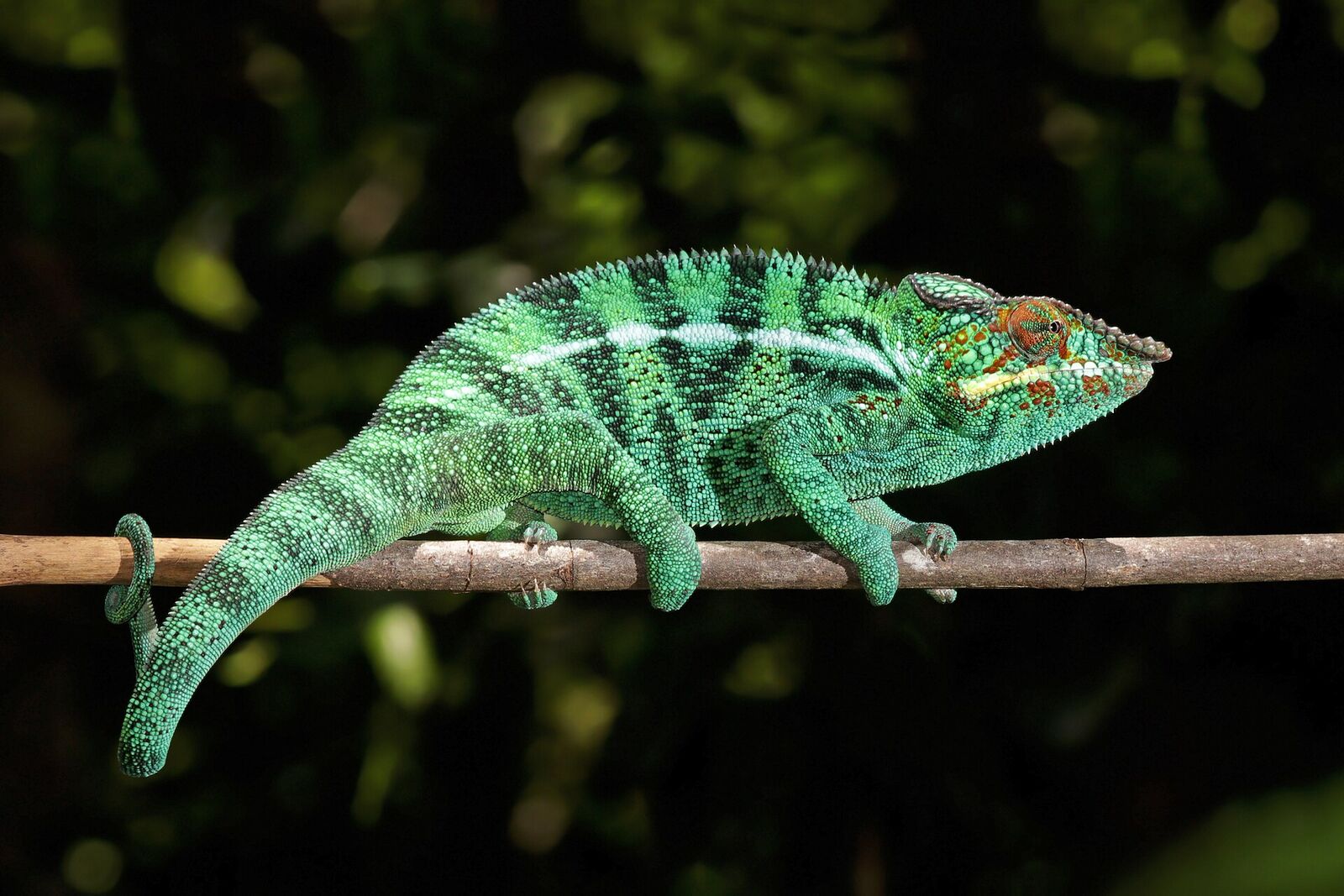
Panther chameleon
Furcifer pardalis
The most colorful chameleon of all.
Pet trade
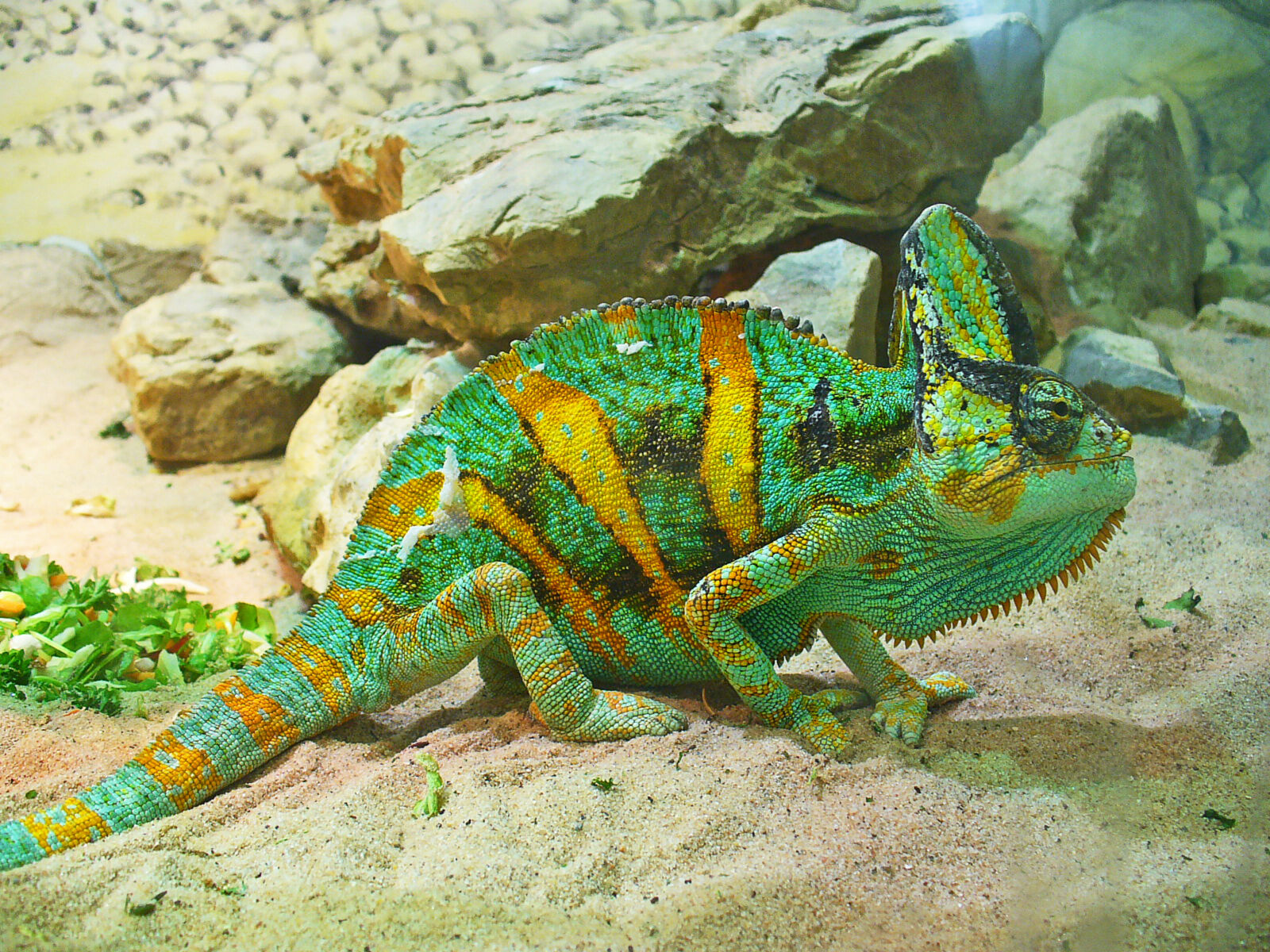
Veiled chameleon
Chamaeleo calyptratus
Color-shifting, independent, look-don't-touch.
Pet trade

Bearded pygmy chameleon
Rieppeleon brevicaudatus
Pet trade

Cape dwarf chameleon
Bradypodion pumilum
Pet trade

Carpet chameleon
Furcifer lateralis
Pet trade

Common chameleon
Chamaeleo chamaeleon
Zoos & aquariums