
Home / Invertebrates / Cockroaches / Death's head cockroach
No federal permit to keepDeath's head cockroach
Blaberus craniifer
Invertebrates › Cockroaches (Blattodea) › Blaberidae (Hissing and feeder roaches)
The death's head cockroach (Blaberus craniifer) is a species of cockroach belonging to the family Blaberidae.
From Wikipedia: Death's head cockroach, CC BY-SA 4.0 (excerpt)

Care at a glance
Species-specific values
Values researched for this exact species. Air, surface and water temperatures are listed separately, and each source is kept as published rather than averaged.
| Minimum enclosure | A 45 × 30 × 30 cm enclosure suits a small colony; larger breeding groups need more floor area and bark surface. Source: academy.herpeton.net | |
| Warm side air temperature | 75–84 °F (24–29 °C) Source: academy.herpeton.net | |
| Warm end temperature | 84–88 °F (29–31 °C) Source: academy.herpeton.net | |
| Cool side air temperature | 68–75 °F (20–24 °C) Source: academy.herpeton.net | |
| Humidity | 55–75 % Source: academy.herpeton.net | |
| Uvb lighting | UVB is not required; provide diffuse light for 10-12 hours and deep shade under bark. Source: academy.herpeton.net | |
| Diet | Keep balanced dry roach food available; offer vegetables, greens, or fruit, plus leaf litter and decayed hardwood. Source: academy.herpeton.net | |
| Feeding frequency | Offer fresh foods two or three times weekly. Source: academy.herpeton.net | |
| Substrate | Use 8-12 cm of rotten hardwood, leaf litter, and coir or topsoil. Source: academy.herpeton.net |
Understanding the animal
About this animal
About this animal
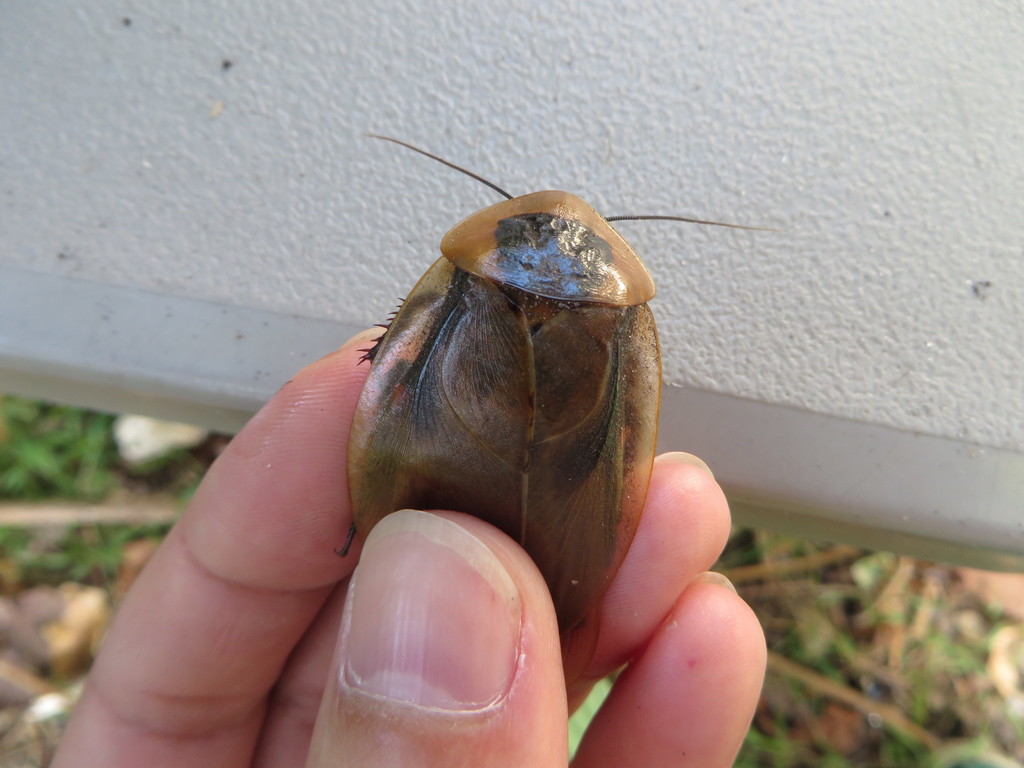
It is often confused with the discoid cockroach, Blaberus discoidalis, due to its similar appearance. It is distinguished by jet black cloak-like marking on its wings and a skull-shaped, amber/black marking on its pronotum.
From Wikipedia: Death's head cockroach, CC BY-SA 4.0 (excerpt)
In the wild
In the wild
| Overview | The death's head cockroach (Blaberus craniifer) is a species of cockroach belonging to the family Blaberidae. It is often confused with the discoid cockroach, Blaberus discoidalis, due to its similar appearance. It is distinguished by jet black cloak-like marking on its wings and a skull-shaped, amber/black marking on its pronotum. The name death's head comes from the markings on the top of the pronotum: "cranii", which is Latin for "of the head", and "fer", meaning "carry" or "carrier". — From Wikipedia: Death's head cockroach, CC BY-SA 4.0 (excerpt) |
| Where it lives | B. craniifer is native to Mexico, the West Indies, and Central America. It has also been introduced into southern Florida in the United States. They can be found on forest floors, hiding in leaf matter and rotting wood. — From Wikipedia: Death's head cockroach, CC BY-SA 4.0 (excerpt) |
| Wild diet | In their native habitats, B. craniifer will feed on any organic food source available, including leaf matter. In captivity, it is recommended they are provided foods like fresh fruit and vegetables, wet dog food and moist cereal. — From Wikipedia: Death's head cockroach, CC BY-SA 4.0 (excerpt) |
| Behavior | In response to a predator approaching or after an attack, B. craniifer burrows itself into softer substrates when possible, using its head and pronotum, allowing the cockroach to hide. Cockroaches are gregarious insects, meaning they often interact and associate with one another. B. craniifer secretes a volatile aggregative pheromone from the mandibular glands when engaging in gregarious behaviour. — From Wikipedia: Death's head cockroach, CC BY-SA 4.0 (excerpt) |
| Reproduction | B. craniifer are ovoviviparous cockroaches and mate once at a time. The act of mating begins with the female emitting a sex pheromone, which stimulates loco-motor activity in the male to approach the female. While the female emits the sex pheromones from pygidial glands, which are located posteriorly on the abdomen, she will also assume a calling posture. — From Wikipedia: Death's head cockroach, CC BY-SA 4.0 (excerpt) |
Native climate (measured)
Native climate (measured)
| Warm-season highs | about 92°F (up to 96°F in the hottest sampled areas) |
| Cool-season lows | about 63°F (down to 60°F in the coldest sampled areas) |
| Average temperature | 77–79°F across sampled records |
| Relative humidity | 76–80% on average (driest month about 70%) |
| Rainfall | about 1228 mm a year |
Measured at 113 wild occurrence records sampled against WorldClim 2.1 climate data (1970–2000 averages). Air conditions in the range are ecological context, not enclosure settings: microhabitats such as burrows, leaf litter or basking rocks can be cooler, warmer or more humid.
Sources for this sheet
- GBIF Backbone Taxonomy (Global Biodiversity Information Facility) (CC BY 4.0) Peer-reviewed researchInternational scientific taxonomy used here for classification. GBIF Secretariat (2023). GBIF Backbone Taxonomy. Checklist dataset https://doi.org/10.15468/39omei, accessed via GBIF.org.
- Wikipedia (species article) (CC BY-SA 4.0) Community referenceFree encyclopedia; useful overviews with their own citations. Short excerpts are quoted under CC BY-SA 4.0, each credited with a link to its article.
- iNaturalist (captive observations) Community referenceCommunity observation platform run by the California Academy of Sciences and National Geographic; observations marked captive show animals living in homes, zoos and aquariums.
More hissing and feeder roaches
Discoid roach
Blaberus discoidalis
Pet trade

Dubia (Argentine wood) roach
Blaptica dubia
Pet trade
Giant Cave Cockroach
Blaberus giganteus
Pet trade

Giant burrowing cockroach
Macropanesthia rhinoceros
Pet trade

Grandidier's giant Madagascan hissing cockroach
Gromphadorhina grandidieri
Pet trade

Madagascar hissing cockroach
Gromphadorhina portentosa
Pet trade