
Home / Reptiles / Lizards / Chamaeleonidae / Petter's chameleon
Some federal rules applyPetter's chameleon
Furcifer petteri
Reptiles › Lizards (Lacertilia) › Chamaeleonidae (Chameleons)
The Petter's chameleon (Furcifer petteri) is a species of chameleon, which is endemic to northern Madagascar.
From Wikipedia: Petter's chameleon, CC BY-SA 4.0 (excerpt)

Care at a glance
Species-specific values
Values researched for this exact species. Air, surface and water temperatures are listed separately, and each source is kept as published rather than averaged.
| Minimum enclosure | Adults should be housed in a screen cage at least 0.4 x 0.4 x 0.5 meters. Source: reptiletalk.net | |
| Basking surface temperature | 84–88 °F (29–31 °C) Source: reptiletalk.net | |
| Humidity | 50–60 % Source: reptiletalk.net | |
| Uvb lighting | Use a HO T5 double fixture with a 6% Arcadia UVB bulb; UVB is required. Source: reptiletalk.net | |
| Feeding frequency | Feed 6–7 days a week. Source: reptiletalk.net | |
| Substrate | No substrate is required. Source: reptiletalk.net |
Understanding the animal
About this animal
About this animal
Furcifer petteri was initially described as the subspecies Chamaeleo willsii petteri by Édouard-Raoul Brygoo and Charles Domergue in 1966, but later transferred to the genus Furcifer and given full species status by Frank Glaw and Miguel Vences in 1994.
From Wikipedia: Petter's chameleon, CC BY-SA 4.0 (excerpt)
In the wild
In the wild
| Overview | The Petter's chameleon (Furcifer petteri) is a species of chameleon, which is endemic to northern Madagascar. Furcifer petteri was initially described as the subspecies Chamaeleo willsii petteri by Édouard-Raoul Brygoo and Charles Domergue in 1966, but later transferred to the genus Furcifer and given full species status by Frank Glaw and Miguel Vences in 1994. — From Wikipedia: Petter's chameleon, CC BY-SA 4.0 (excerpt) |
| Where it lives | Furcifer petteri is endemic to Madagascar. Its type locality is the eastern edge of the Ankarana Reserve, specifically the Ankarana massif. — From Wikipedia: Petter's chameleon, CC BY-SA 4.0 (excerpt) |
| Appearance and size | Male specimens are roughly between 16 and 18 cm in total length (including tail), and their main colour is deep green with lateral white stripes and white lips. The female specimens are slightly smaller than the males, and have similar colouration. When the females are excited, they change colours quickly, becoming yellow-lemon with two spots of light blue, and one of red. — From Wikipedia: Petter's chameleon, CC BY-SA 4.0 (excerpt) |
| Conservation | Furcifer petteri is listed as a vulnerable species by the International Union for Conservation of Nature (IUCN) because its geographic range only covers an area of 11000 sqkm in northern Madagascar, where the remaining forest is in decline. It lives between 120 and 850 m above mean sea level, where it is threatened by mining, logging for rosewood and charcoal, and fires. — From Wikipedia: Petter's chameleon, CC BY-SA 4.0 (excerpt) |
Read about this species in the wild at The Reptile Database.
Native climate (measured)
Native climate (measured)
| Warm-season highs | about 88°F (up to 89°F in the hottest sampled areas) |
| Cool-season lows | about 64°F (down to 55°F in the coldest sampled areas) |
| Average temperature | 72–78°F across sampled records |
| Relative humidity | 72–74% on average (driest month about 66%) |
| Rainfall | about 1424 mm a year, with strong wet and dry seasons |
Measured at 5 wild occurrence records sampled against WorldClim 2.1 climate data (1970–2000 averages). Air conditions in the range are ecological context, not enclosure settings: microhabitats such as burrows, leaf litter or basking rocks can be cooler, warmer or more humid.
Profile
Profile
Researched for this exact species. Sources are listed under In the wild above.
Data and studies
The numbers
The numbers
Each bar is what one source reports. Where several sources weigh in, the dashed gold band marks their average.
Incubation
Sources for this sheet
- Myhrvold et al. (2015). An amniote life-history database. Ecology 96: 3109 Peer-reviewed researchPeer-reviewed compilation of life-history data for over 21,000 birds, mammals and reptiles.
- Species+ (UNEP-WCMC and the CITES Secretariat) Zoo, university or veterinaryThe official database of species listed under CITES. UNEP (2026). The Species+ Website. Nairobi, Kenya. Compiled by UNEP-WCMC, Cambridge, UK. Available at: www.speciesplus.net. [Accessed 04/10/2026].
- USFWS International Affairs: CITES Zoo, university or veterinaryFederal agency that issues CITES permits.
- The Reptile Database Peer-reviewed researchScientist-curated catalog of every reptile species, with taxonomy and literature.
- GBIF Backbone Taxonomy (Global Biodiversity Information Facility) (CC BY 4.0) Peer-reviewed researchInternational scientific taxonomy used here for classification. GBIF Secretariat (2023). GBIF Backbone Taxonomy. Checklist dataset https://doi.org/10.15468/39omei, accessed via GBIF.org.
- Wikipedia (species article) (CC BY-SA 4.0) Community referenceFree encyclopedia; useful overviews with their own citations. Short excerpts are quoted under CC BY-SA 4.0, each credited with a link to its article.
More chameleons
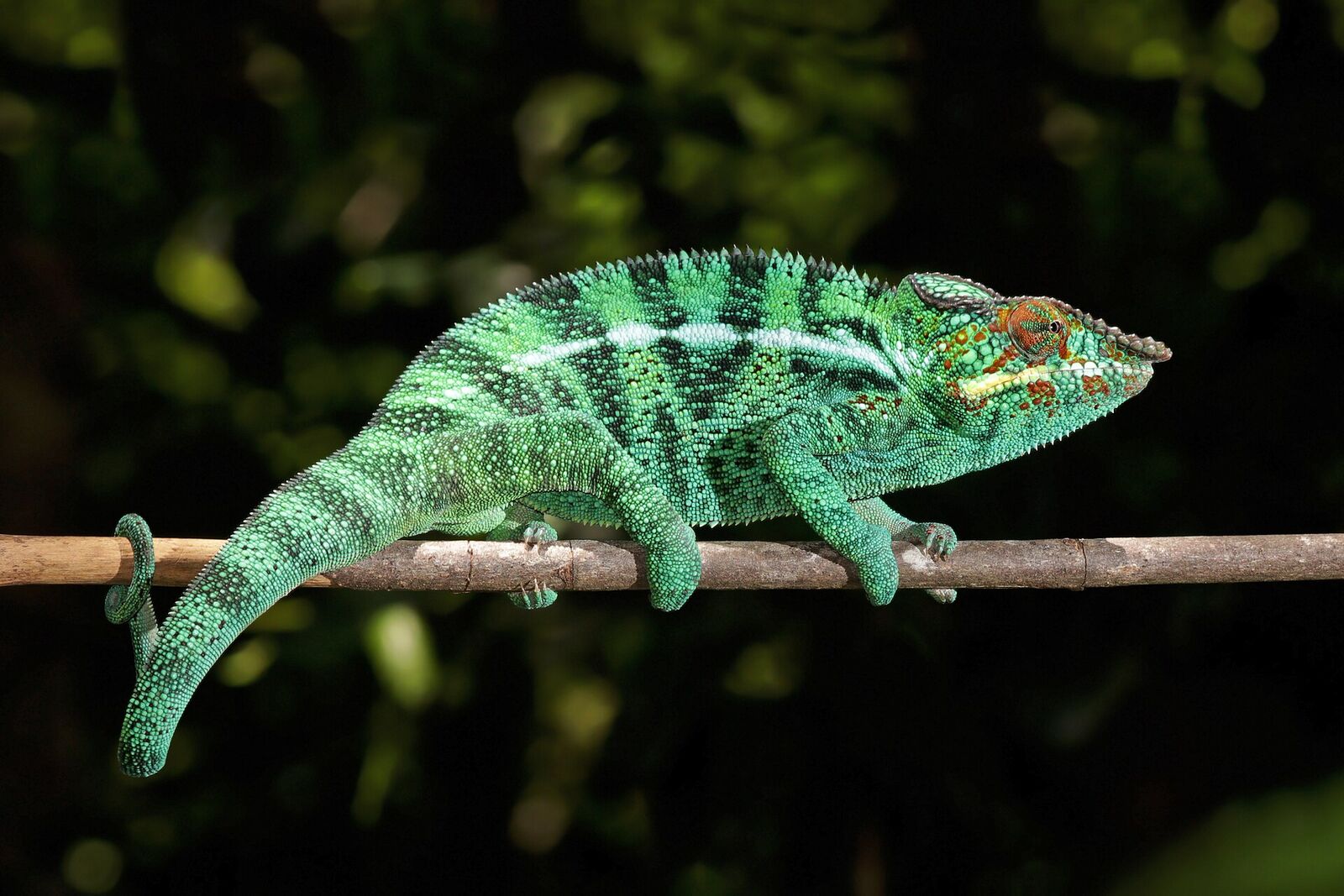
Panther chameleon
Furcifer pardalis
The most colorful chameleon of all.
Pet trade
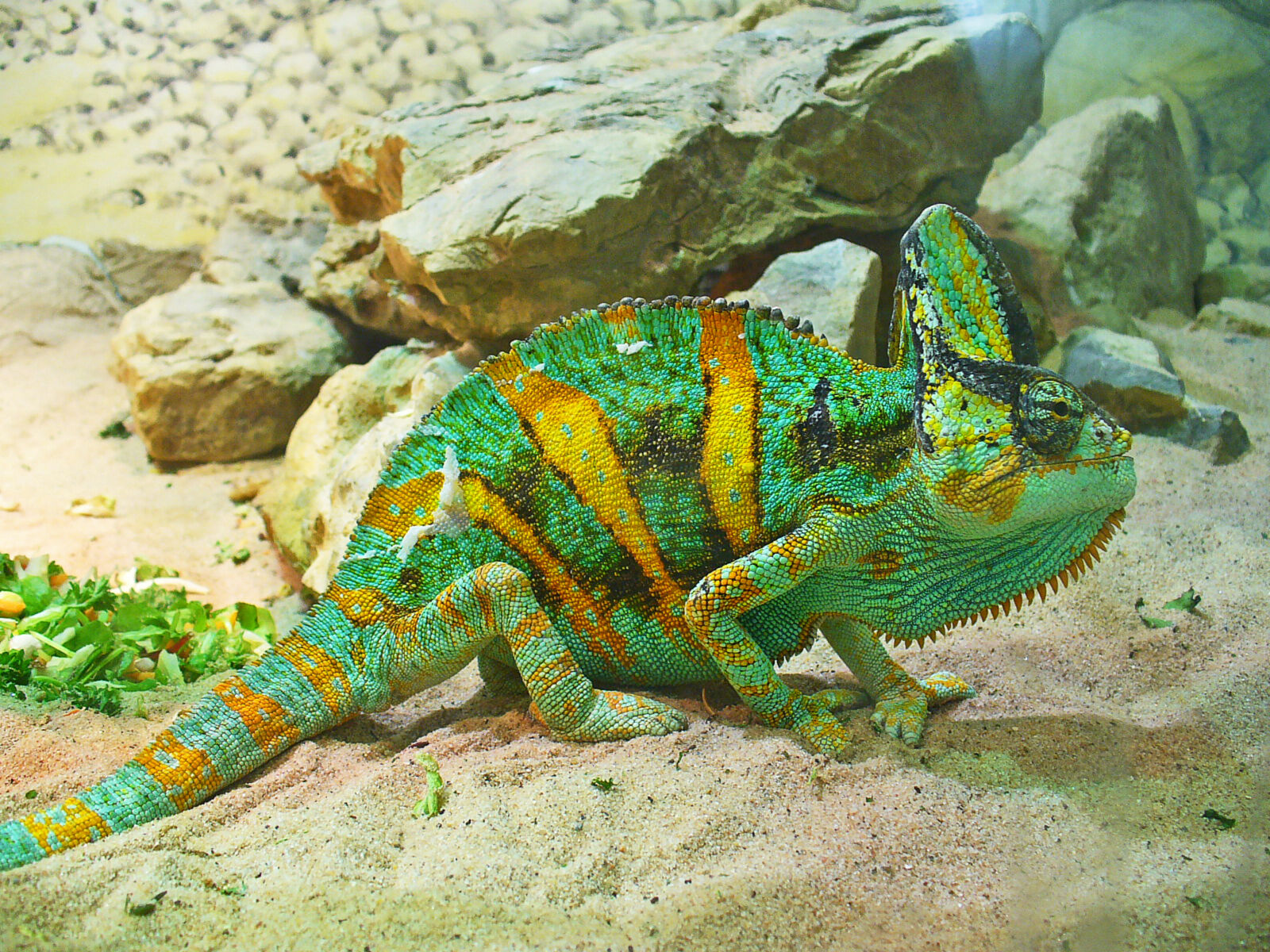
Veiled chameleon
Chamaeleo calyptratus
Color-shifting, independent, look-don't-touch.
Pet trade

Bearded pygmy chameleon
Rieppeleon brevicaudatus
Pet trade

Cape dwarf chameleon
Bradypodion pumilum
Pet trade

Carpet chameleon
Furcifer lateralis
Pet trade

Common chameleon
Chamaeleo chamaeleon
Zoos & aquariums