
Home / Invertebrates / Ants and bees / Honeypot ant
No federal permit to keepHoneypot ant
Myrmecocystus mexicanus
Invertebrates › Ants and bees (Hymenoptera) › Formicidae (Ants)
Experience: Easy
FamilyAnts
Kept byPet trade
Care at a glance
Species-specific values
Values researched for this exact species. Air, surface and water temperatures are listed separately, and each source is kept as published rather than averaged.
| Warm side air temperature | 75–84 °F (24–29 °C) Source: antomas.es | |
| Warm spot temperature | 82–86 °F (28–30 °C) Source: antomas.es | |
| Humidity | Keep a humidity gradient with a hydrated area for eggs and larvae and dry replete chambers. Source: antomas.es | |
| Diet | Offer carbohydrates such as nectar, sugar water, diluted honey, syrups, or ripe fruit, plus protein insects and clean water. Source: antomas.es | |
| Feeding frequency | For mini-colonies, offer controlled microdrops and wait until the second or third worker generation before installing larger or continuous nectar feeders. Source: antomas.es | |
| Substrate | For large colonies in chamberless nests, use a compact, stable substrate that holds chambers without collapsing. Source: antomas.es | |
| Seasonal cooling | 54–63 °F (12–17 °C) Source: antomas.es |
Understanding the animal
In the wild
In the wild
| Overview | Myrmecocystus mexicanus, the Mexican honeypot ant, is a species of ant in the genus Myrmecocystus, which is one of the six genera that bear the common name "honey ant" or "honeypot ant", due to curious behavior where some of the workers will swell with liquid food until they become immobile and hang from the ceilings of nest chambers, acting as living food storage for the colony. Honey ants are found in North America, Australia, and Africa. Ant species belonging to the genus Myrmecocystus reside in North America. — From Wikipedia: Myrmecocystus mexicanus, CC BY-SA 4.0 (excerpt) |
| Social life and communication | M. mexicanus like many ants, wasps and bees, is a eusocial insect species. Eusocial insects are characterized by distinct caste systems, where some individuals breed and most individuals are sterile helpers, and overlapping generations so mother, adult offspring and immature offspring are all living at the same time. — From Wikipedia: Myrmecocystus mexicanus, CC BY-SA 4.0 (excerpt) |
| Behavior | As workers forage, their abdomens become clear and distended, similar to replete workers. When they return to the nest, they regurgitate their collected nectar into replete workers for storage. March through November is the typical foraging time for M. mexicanus. — From Wikipedia: Myrmecocystus mexicanus, CC BY-SA 4.0 (excerpt) |
| Reproduction | Only two castes in the colony reproduce, the queens and the males. Workers are sterile and tend to the queen and brood. Mating occurs during nuptial flights, where winged queens and males swarm outside the nest. — From Wikipedia: Myrmecocystus mexicanus, CC BY-SA 4.0 (excerpt) |
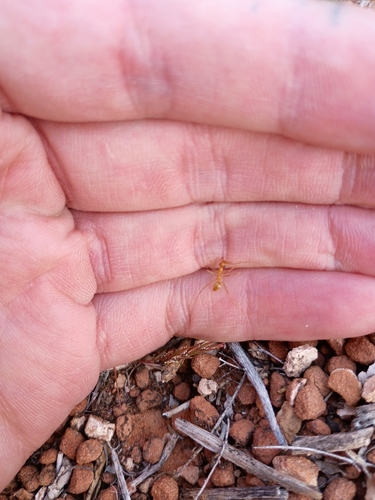
| Appearance and size | Workers range from 3–7 mm in length and have a light tan thorax, legs and slightly darker head with black mandibles. The gaster is brownish-gray. Queens are roughly 9 mm in length. — From Wikipedia: Myrmecocystus mexicanus, CC BY-SA 4.0 (excerpt) |
Sources for this sheet
- GBIF Backbone Taxonomy (Global Biodiversity Information Facility) (CC BY 4.0) Peer-reviewed researchInternational scientific taxonomy used here for classification. GBIF Secretariat (2023). GBIF Backbone Taxonomy. Checklist dataset https://doi.org/10.15468/39omei, accessed via GBIF.org.
- iNaturalist (captive observations) Community referenceCommunity observation platform run by the California Academy of Sciences and National Geographic; observations marked captive show animals living in homes, zoos and aquariums.
More ants

No federal permit
Black garden ant
Lasius niger
Pet trade
Easy
No federal permit
California harvester ant
Pogonomyrmex californicus
Pet trade
Easy

No federal permit
Florida carpenter ant
Camponotus floridanus
Pet trade
Easy

No federal permit
Leafcutter ant
Atta cephalotes
Pet trade
Easy

No federal permit
Mediterranean harvester ant
Messor barbarus
Pet trade
Easy

No federal permit
Pavement ant
Tetramorium immigrans
Pet trade
Easy