
Home / Invertebrates / Ants and bees / Mediterranean harvester ant
No federal permit to keepMediterranean harvester ant
Messor barbarus
Invertebrates › Ants and bees (Hymenoptera) › Formicidae (Ants)
Experience: Easy

FamilyAnts
Kept byPet trade
Care at a glance
Species-specific values
Values researched for this exact species. Air, surface and water temperatures are listed separately, and each source is kept as published rather than averaged.
| Warm side air temperature | 68–82 °F (20–28 °C) Source: antsdavey.co.uk | |
| Humidity | 50–70 % Source: antsdavey.co.uk | |
| Humidity | 30–50 % Source: antsdavey.co.uk | |
| Night temperature | 50–59 °F (10–15 °C) Source: antsdavey.co.uk | |
| Water temperature | Keep water available at all times during hibernation. Source: antsdavey.co.uk | |
| Diet | Provide seeds at all times once workers arrive. Source: antsdavey.co.uk | |
| Feeding frequency | Founding colonies need protein and carbohydrates once a week. Source: antsdavey.co.uk | |
| Feeding frequency | Offer a small amount of protein three days after carbohydrate feeding; remove leftovers after another three days. Source: antsdavey.co.uk | |
| Social housing | House as a colony; the stated type is one queen per colony. Source: antsdavey.co.uk | |
| Substrate | Possible nest materials include acrylic, encased Ytong, wood, 3D-printed, or natural bioactive setups. Source: antsdavey.co.uk | |
| Seasonal cooling | Hibernation is required from late October through late March; first hibernation may be skipped, with hibernation recommended the next year. Source: antsdavey.co.uk |
Understanding the animal
In the wild
In the wild
| Overview | Messor barbarus is a species of harvester ant in the subfamily Myrmicinae. It is found In Southern Europe and Northern Africa. — From Wikipedia: Messor barbarus, CC BY-SA 4.0 (excerpt) |
| Behavior | Messor barbarus is found to act in accordance with the optimal foraging theory, which predicts that selectivity in ants increases with increasing richness of resources in an area, as well as with increasing distance from starting location. Trails were likewise differentially favored according to the relative abundance of resources provided to the ant populations. — From Wikipedia: Messor barbarus, CC BY-SA 4.0 (excerpt) |
Sources for this sheet
- GBIF Backbone Taxonomy (Global Biodiversity Information Facility) (CC BY 4.0) Peer-reviewed researchInternational scientific taxonomy used here for classification. GBIF Secretariat (2023). GBIF Backbone Taxonomy. Checklist dataset https://doi.org/10.15468/39omei, accessed via GBIF.org.
- iNaturalist (captive observations) Community referenceCommunity observation platform run by the California Academy of Sciences and National Geographic; observations marked captive show animals living in homes, zoos and aquariums.
More ants

No federal permit
Black garden ant
Lasius niger
Pet trade
Easy
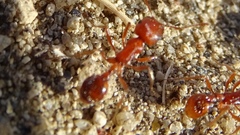
No federal permit
California harvester ant
Pogonomyrmex californicus
Pet trade
Easy

No federal permit
Florida carpenter ant
Camponotus floridanus
Pet trade
Easy
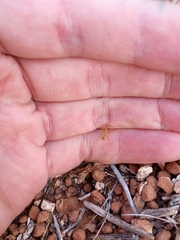
No federal permit
Honeypot ant
Myrmecocystus mexicanus
Pet trade
Easy

No federal permit
Leafcutter ant
Atta cephalotes
Pet trade
Easy

No federal permit
Pavement ant
Tetramorium immigrans
Pet trade
Easy