
Home / Reptiles / Lizards / Teiidae / Northern caiman lizard
Some federal rules applyNorthern caiman lizard
Dracaena guianensis
Reptiles › Lizards (Lacertilia) › Teiidae (Tegus and whiptails)
The northern caiman lizard (Dracaena guianensis) is a species of lizard found in northern South America.
From Wikipedia: Northern caiman lizard, CC BY-SA 4.0 (excerpt)

Care at a glance
Species-specific values
Values researched for this exact species. Air, surface and water temperatures are listed separately, and each source is kept as published rather than averaged.
| Minimum enclosure | Full-grown pets need a cage measuring 6 feet in length, 3 feet in width, and 4 feet in height. Source: reptilesmagazine.com | |
| Basking surface temperature | at least 100 °F Source: reptilesmagazine.com | |
| Warm side air temperature | 80–90 °F Source: reptilesmagazine.com | |
| Water temperature | 75–85 °F Source: reptilesmagazine.com | |
| Uvb lighting | Provide access to UVB, UVA, and full spectrum visible daylight for a 12–14 hour daylight period. Source: reptilesmagazine.com | |
| Diet | Offer varied foods including snails, shrimp, insects, canned Tegu and monitor food, and fruit; supplement with multivitamin and calcium. Source: reptilesmagazine.com | |
| Humidity | 60–80 % Source: reptilesmagazine.com |
Understanding the animal
In the wild
In the wild
Researched for this exact species, not its family. Wild conditions are context, not enclosure settings.1234
| Where it lives | Northern South American wet forest, swamps and flooded woodlands. Forages in water and uses trees for shelter. |
| Ground it lives on | Wet banks and branches above water. |
| Climate | Wet tropical habitat; measured wild temperature and humidity ranges were not established. |
| Active | Diurnal; rests in trees at night. |
| Wild diet | Especially snails, plus crustaceans, insects and fish. |
| Behavior to plan for | An excellent swimmer that shelters in trees at night. Strong jaws process hard-shelled prey. |
Native climate (measured)
Native climate (measured)
| Warm-season highs | about 89°F (up to 90°F in the hottest sampled areas) |
| Cool-season lows | about 69°F (down to 67°F in the coldest sampled areas) |
| Average temperature | 77–80°F across sampled records |
| Relative humidity | 83–85% on average (driest month about 82%) |
| Rainfall | about 2867 mm a year, spread fairly evenly |
Measured at 109 wild occurrence records sampled against WorldClim 2.1 climate data (1970–2000 averages). Air conditions in the range are ecological context, not enclosure settings: microhabitats such as burrows, leaf litter or basking rocks can be cooler, warmer or more humid.
Profile
Profile
Researched for this exact species. Sources are listed under In the wild above.
History
The species was heavily hunted for its hide. It received protection in 1970, after which skin exports declined; captive farms were later established for the leather trade, and in more recent years some animals have entered the pet trade.
Data and studies
The numbers
The numbers
Each bar is what one source reports. Where several sources weigh in, the dashed gold band marks their average.
Maximum recorded lifespan
Longest recorded lifespan reported by each database; typical lifespans are usually shorter. The AnAge record comes from an animal in human care.
Typical adult weight
Average adult body mass in each database (FishBase gives the maximum recorded weight).
Adult snout-to-vent length
Body length without the tail.
Incubation
Veterinary & husbandry research
Veterinary & husbandry research
- CAUSES OF MORTALITY AND COMORBIDITIES IN CAIMAN LIZARDS (DRACAENA GUIANENSIS) AT SIX ZOOLOGICAL INSTITUTIONS Cerreta AJ et al., Journal of zoo and wildlife medicine: official publication of the American Association of Zoo Veterinarians 2023
- MULTIPLE INFECTIONS IN CAIMAN LIZARDS (DRACAENA GUIANENSIS) IMPORTED INTO EUROPE FROM PERU Marschang RE et al., Journal of zoo and wildlife medicine: official publication of the American Association of Zoo Veterinarians 2025
Peer-reviewed papers that mention this species alongside captivity, zoos, veterinary care or aquaculture. Some cover several species or mention it only in passing, so check the abstract. PubMed
Sources for this sheet
- AnAge: The Animal Ageing and Longevity Database (Human Ageing Genomic Resources) (CC BY 3.0) Peer-reviewed researchCurated, referenced longevity and life-history records for thousands of species; maximum lifespans are often from zoo animals.
- Myhrvold et al. (2015). An amniote life-history database. Ecology 96: 3109 Peer-reviewed researchPeer-reviewed compilation of life-history data for over 21,000 birds, mammals and reptiles.
- Species+ (UNEP-WCMC and the CITES Secretariat) Zoo, university or veterinaryThe official database of species listed under CITES. UNEP (2026). The Species+ Website. Nairobi, Kenya. Compiled by UNEP-WCMC, Cambridge, UK. Available at: www.speciesplus.net. [Accessed 04/10/2026].
- USFWS International Affairs: CITES Zoo, university or veterinaryFederal agency that issues CITES permits.
- Clint's Reptiles (YouTube): Caiman Lizard, The Best Pet Lizard? Expert educator & keeperClint Laidlaw, PhD in Biology Education and MS in Evolutionary Ecology; owner of Clint's Reptile Room and a longtime keeper. His "Best Pet?" series reviews each species' care in depth.
- The Reptile Database Peer-reviewed researchScientist-curated catalog of every reptile species, with taxonomy and literature.
- GBIF Backbone Taxonomy (Global Biodiversity Information Facility) (CC BY 4.0) Peer-reviewed researchInternational scientific taxonomy used here for classification. GBIF Secretariat (2023). GBIF Backbone Taxonomy. Checklist dataset https://doi.org/10.15468/39omei, accessed via GBIF.org.
- Wikipedia (species article) (CC BY-SA 4.0) Community referenceFree encyclopedia; useful overviews with their own citations. Short excerpts are quoted under CC BY-SA 4.0, each credited with a link to its article.
- PubMed (U.S. National Library of Medicine) Peer-reviewed researchIndex of peer-reviewed veterinary, zoo and husbandry research.
- iNaturalist (captive observations) Community referenceCommunity observation platform run by the California Academy of Sciences and National Geographic; observations marked captive show animals living in homes, zoos and aquariums.
More tegus and whiptails
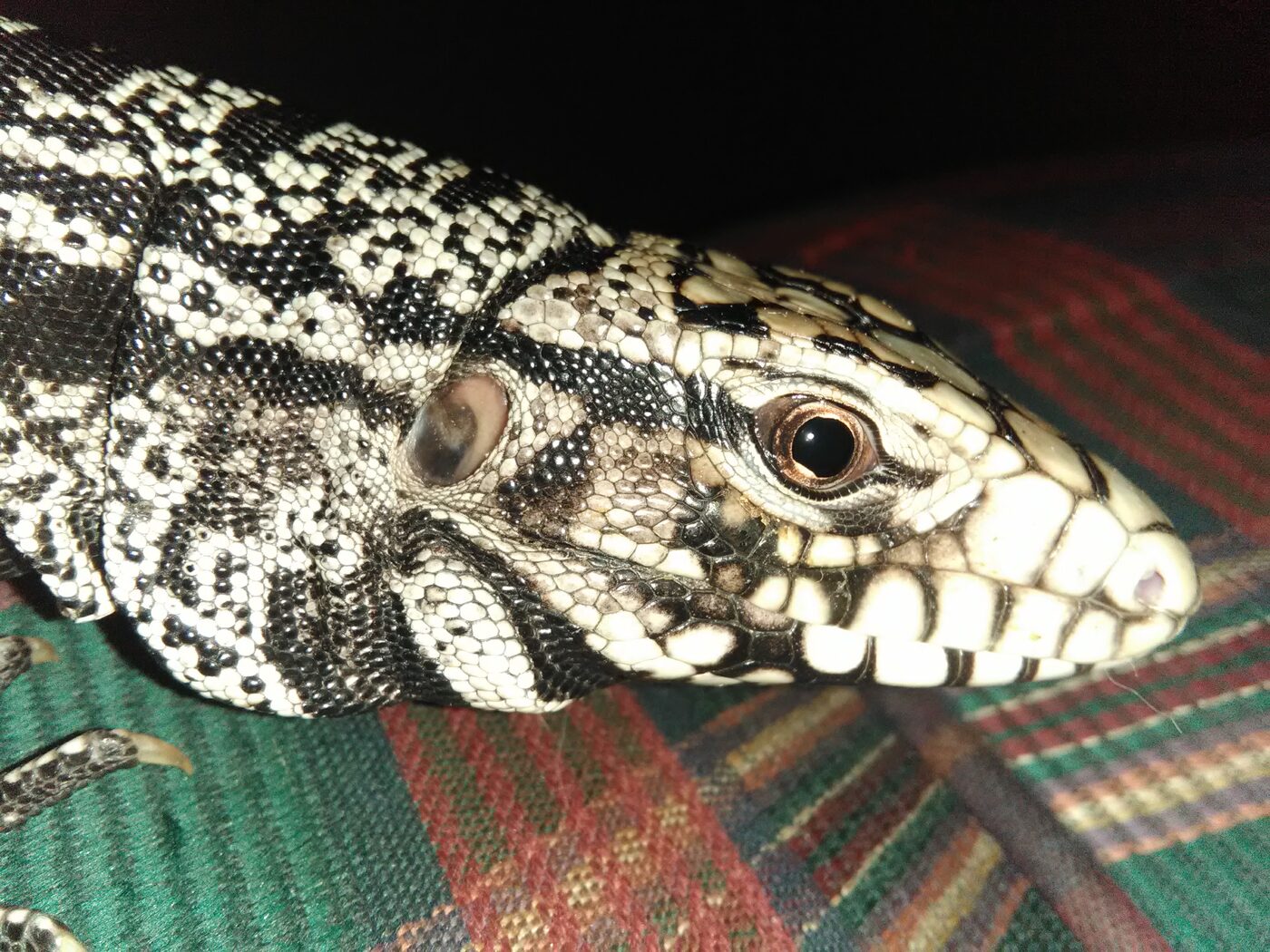
Argentine black and white tegu
Salvator merianae
Pet trade

Crocodile tegu
Crocodilurus amazonicus
Pet trade
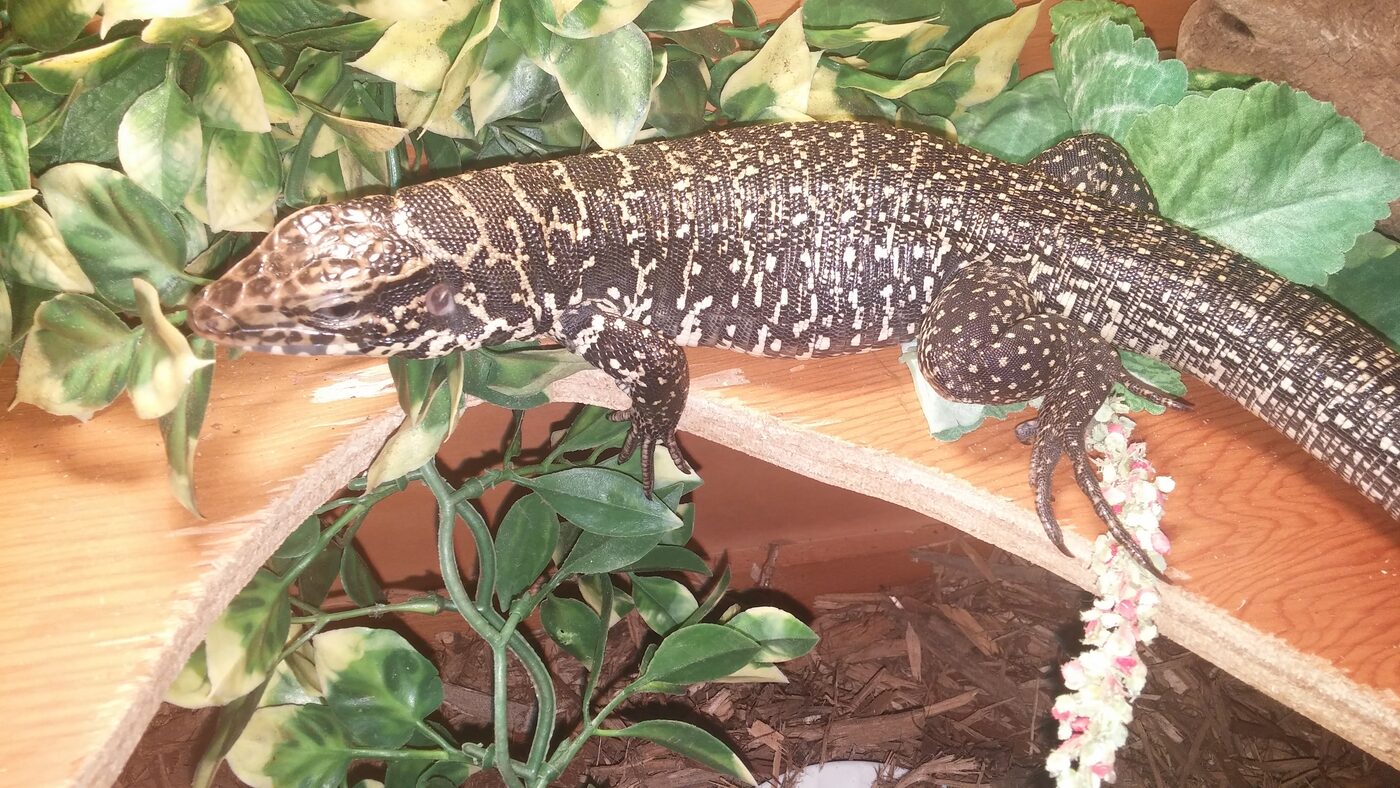
Gold (Colombian) tegu
Tupinambis teguixin
Pet trade

Red tegu
Salvator rufescens
Pet trade

Western whiptail
Aspidoscelis tigris
Pet trade