
Home / Invertebrates / Ants and bees / Weaver ant
No federal permit to keepWeaver ant
Oecophylla smaragdina
Invertebrates › Ants and bees (Hymenoptera) › Formicidae (Ants)
Experience: Easy

FamilyAnts
Kept byPet trade
Care at a glance
Species-specific values
Values researched for this exact species. Air, surface and water temperatures are listed separately, and each source is kept as published rather than averaged.
| Warm side air temperature | 77 °F (25 °C) Source: thewildmartin.com | |
| Warm side air temperature | 86 °F (30 °C) Source: thewildmartin.com | |
| Warm side air temperature | 75–90 °F (24–32 °C) Source: formicamarket.com | |
| Humidity | 60–80 % Source: formicamarket.com | |
| Diet | Offer live insect protein and a clean sugar source; keep fresh water available. Source: formicamarket.com | |
| Feeding frequency | Feed protein two to three times per week and replenish carbohydrates daily for a growing colony. Source: formicamarket.com | |
| Seasonal cooling | No dormancy; maintain the stated temperature and humidity ranges consistently year-round. Source: formicamarket.com | |
| Uvb lighting | Use lighting on a roughly twelve-hour natural tropical photoperiod. Source: formicamarket.com |
Understanding the animal
In the wild
In the wild
| Overview | Oecophylla smaragdina (common names include Asian weaver ant, weaver ant, green ant, green tree ant, and orange gaster) is a species of arboreal ant found in tropical Asia and Australia. These ants form colonies with multiple nests in trees, each nest being made of leaves stitched together using the silk produced by the ant larvae, hence the specific name oecophylla (Greek for "leaf-house"). — From Wikipedia: Oecophylla smaragdina, CC BY-SA 4.0 (excerpt) |
| Where it lives | Oecophylla smaragdina has a widespread distribution in tropical Asia and Australia, with its range extending from India through Indonesia and the Philippines to Northern Territory and Queensland in Australia. It is an arboreal species, making its nests among the foliage of trees. Nests are constructed during the night, with major workers weaving towards the exterior and minor workers completing the interior structure. — From Wikipedia: Oecophylla smaragdina, CC BY-SA 4.0 (excerpt) |
| Appearance and size | Workers and major workers are mostly coloured orange. Workers are 5–7 mm long; they look after larvae and farm scale bugs for honeydew. Major workers are 8–10 mm long, with long, strong legs and large mandibles. — From Wikipedia: Oecophylla smaragdina, CC BY-SA 4.0 (excerpt) |
Sources for this sheet
- GBIF Backbone Taxonomy (Global Biodiversity Information Facility) (CC BY 4.0) Peer-reviewed researchInternational scientific taxonomy used here for classification. GBIF Secretariat (2023). GBIF Backbone Taxonomy. Checklist dataset https://doi.org/10.15468/39omei, accessed via GBIF.org.
- iNaturalist (captive observations) Community referenceCommunity observation platform run by the California Academy of Sciences and National Geographic; observations marked captive show animals living in homes, zoos and aquariums.
More ants

No federal permit
Black garden ant
Lasius niger
Pet trade
Easy
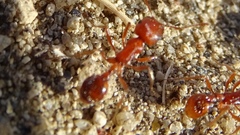
No federal permit
California harvester ant
Pogonomyrmex californicus
Pet trade
Easy

No federal permit
Florida carpenter ant
Camponotus floridanus
Pet trade
Easy
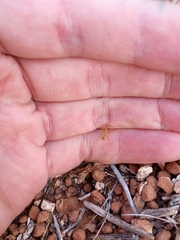
No federal permit
Honeypot ant
Myrmecocystus mexicanus
Pet trade
Easy

No federal permit
Leafcutter ant
Atta cephalotes
Pet trade
Easy

No federal permit
Mediterranean harvester ant
Messor barbarus
Pet trade
Easy