
Home / Birds / Songbirds and perching birds / Two-barred crossbill
Federal permit requiredTwo-barred crossbill
Loxia leucoptera
Birds › Songbirds and perching birds (Passeriformes) › Fringillidae (Finches and canaries)
The two-barred crossbill or white-winged crossbill (Loxia leucoptera) is a small passerine bird in the finch family Fringillidae.
From Wikipedia: Two-barred crossbill, CC BY-SA 4.0 (excerpt)

Care at a glance
Species-specific values
Values researched for this exact species. Air, surface and water temperatures are listed separately, and each source is kept as published rather than averaged.
| Minimum enclosure | A pair of crossbills needs at least 75 cm of enclosure length. Source: birdscoo.com | |
| Social housing | The enclosure length is specified for a pair of crossbills. Source: birdscoo.com | |
| Substrate | Enclosure coverings are generally kraft paper or newspaper. Source: birdscoo.com | |
| Diet | The article says the birds specialize in seeds from tamarack and spruce cones. Source: birdscoo.com |
Warnings
Understanding the animal
About this animal
About this animal
It breeds in the coniferous forests of North America and the Palearctic.
From Wikipedia: Two-barred crossbill, CC BY-SA 4.0 (excerpt)
In the wild
In the wild
| Overview | The two-barred crossbill or white-winged crossbill (Loxia leucoptera) is a small passerine bird in the finch family Fringillidae. It breeds in the coniferous forests of North America and the Palearctic. — From Wikipedia: Two-barred crossbill, CC BY-SA 4.0 (excerpt) |
| Where it lives | This bird breeds in the coniferous forests of Alaska, Canada, the northernmost United States and across the Palearctic extending into northeast Europe. It nests in conifers, laying 3–5 eggs. This crossbill is mainly resident, but will irregularly irrupt south if its food source fails. — From Wikipedia: Two-barred crossbill, CC BY-SA 4.0 (excerpt) |
| Wild diet | They are specialist feeders on conifer cones, and the unusual bill shape is an adaptation to assist the extraction of the seeds from the cone. The two-barred crossbill has a strong preference for larch (Larix), in Eurosiberia using Siberian larch (Larix sibirica) and Dahurian larch (L. gmelinii), and in North America Tamarack larch (L. laricina). — From Wikipedia: Two-barred crossbill, CC BY-SA 4.0 (excerpt) |
| Reproduction | The nest is placed 2–20 m above the ground, usually against the trunk of a conifer. The nest is built by the female and mainly consists of conifer twigs. The clutch of 3–4 eggs is incubated by the female for 14–15 days. — From Wikipedia: Two-barred crossbill, CC BY-SA 4.0 (excerpt) |
| Appearance and size | The two-barred crossbill is 14.5–17 cm in length and weighs 25–40 g. It has short legs, a forked tail, a crossed bill and two prominent white wing-bars. The male of the nominate subspecies has forehead, crown, nape and upper-parts bright raspberry-red. — From Wikipedia: Two-barred crossbill, CC BY-SA 4.0 (excerpt) |
| History and naming | The two-barred crossbill was formally described in 1789 by the German naturalist Johann Friedrich Gmelin in his revised and expanded edition of Carl Linnaeus's Systema Naturae. He placed it with the crossbills in the genus Loxia and coined the binomial name Loxia leucoptera. Gmelin specified the locality as Hudson Bay and New York. — From Wikipedia: Two-barred crossbill, CC BY-SA 4.0 (excerpt) |
Native climate (measured)
Native climate (measured)
| Warm-season highs | about 74°F (up to 83°F in the hottest sampled areas) |
| Cool-season lows | about -1°F (down to -17°F in the coldest sampled areas) |
| Average temperature | 28–48°F across sampled records |
| Relative humidity | 71–81% on average (driest month about 63%) |
| Rainfall | about 778 mm a year, spread fairly evenly |
| Winters | Cool to cold winters (lows around -1°F) in much of its native range. Seasonal slowdown may be relevant, but species-specific biology determines whether brumation or hibernation occurs. |
Measured at 1182 wild occurrence records sampled against WorldClim 2.1 climate data (1970–2000 averages). Air conditions in the range are ecological context, not enclosure settings: microhabitats such as burrows, leaf litter or basking rocks can be cooler, warmer or more humid.
Profile
Profile
Researched for this exact species. Sources are listed under In the wild above.
History
The two-barred crossbill was formally described in 1789 by the German naturalist Johann Friedrich Gmelin in his revised and expanded edition of Carl Linnaeus's Systema Naturae. He placed it with the crossbills in the genus Loxia and coined the binomial name Loxia leucoptera. Gmelin specified the locality as Hudson Bay and New York.
From Wikipedia: Two-barred crossbill, CC BY-SA 4.0 (excerpt)
Data and studies
The numbers
The numbers
Each bar is what one source reports. Where several sources weigh in, the dashed gold band marks their average.
Maximum recorded lifespan
Longest recorded lifespan reported by each database; typical lifespans are usually shorter. The AnAge record comes from an animal in human care.
Typical adult weight
Average adult body mass in each database (FishBase gives the maximum recorded weight).
Clutch size
Average per litter or clutch.
Incubation
Sources for this sheet
- AnAge: The Animal Ageing and Longevity Database (Human Ageing Genomic Resources) (CC BY 3.0) Peer-reviewed researchCurated, referenced longevity and life-history records for thousands of species; maximum lifespans are often from zoo animals.
- Myhrvold et al. (2015). An amniote life-history database. Ecology 96: 3109 Peer-reviewed researchPeer-reviewed compilation of life-history data for over 21,000 birds, mammals and reptiles.
- 50 CFR 10.13: List of migratory birds Zoo, university or veterinaryCurrent federal regulation listing birds protected by the Migratory Bird Treaty Act.
- USFWS Migratory Bird Program Zoo, university or veterinaryFederal agency that administers migratory bird permits.
- 9 CFR 2.1: Animal Welfare Act licensing (USDA) Zoo, university or veterinaryWho needs a USDA license to breed, sell or exhibit animals.
- Wikipedia (species article) (CC BY-SA 4.0) Community referenceFree encyclopedia; useful overviews with their own citations. Short excerpts are quoted under CC BY-SA 4.0, each credited with a link to its article.
- iNaturalist (captive observations) Community referenceCommunity observation platform run by the California Academy of Sciences and National Geographic; observations marked captive show animals living in homes, zoos and aquariums.
More finches and canaries
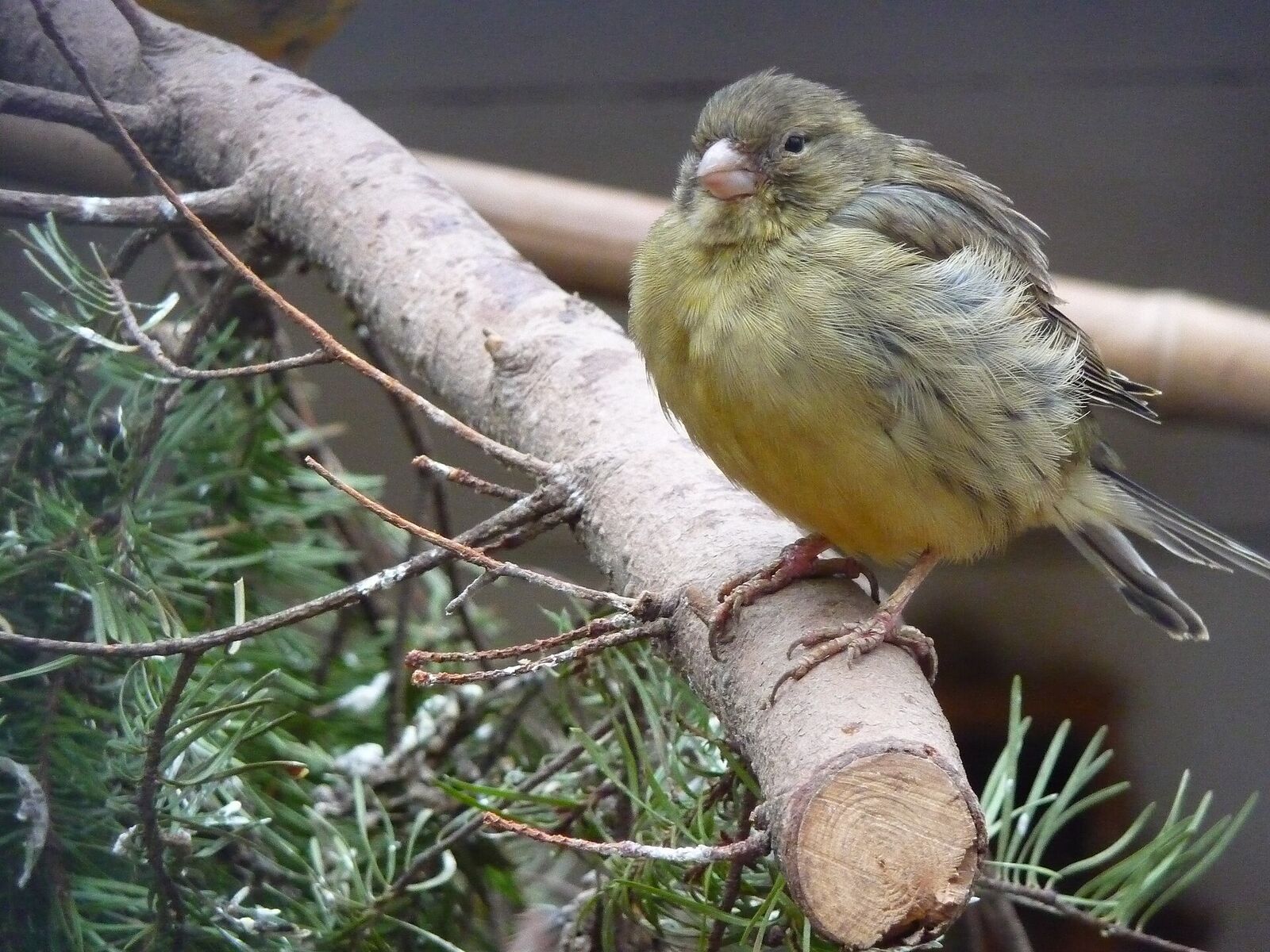
Domestic canary
Serinus canaria
Centuries of song in a small bird.
Pet trade

Black siskin
Spinus atratus
Aviary

Black-chinned siskin
Spinus barbatus
Aviary

Black-headed siskin
Spinus notatus
Aviary

Eurasian chaffinch
Fringilla coelebs
Zoos & aquariums

European goldfinch
Carduelis carduelis
Pet trade