
Home / Birds / Songbirds and perching birds / Yellow canary
No federal permit to keepYellow canary
Crithagra flaviventris
Birds › Songbirds and perching birds (Passeriformes) › Fringillidae (Finches and canaries)
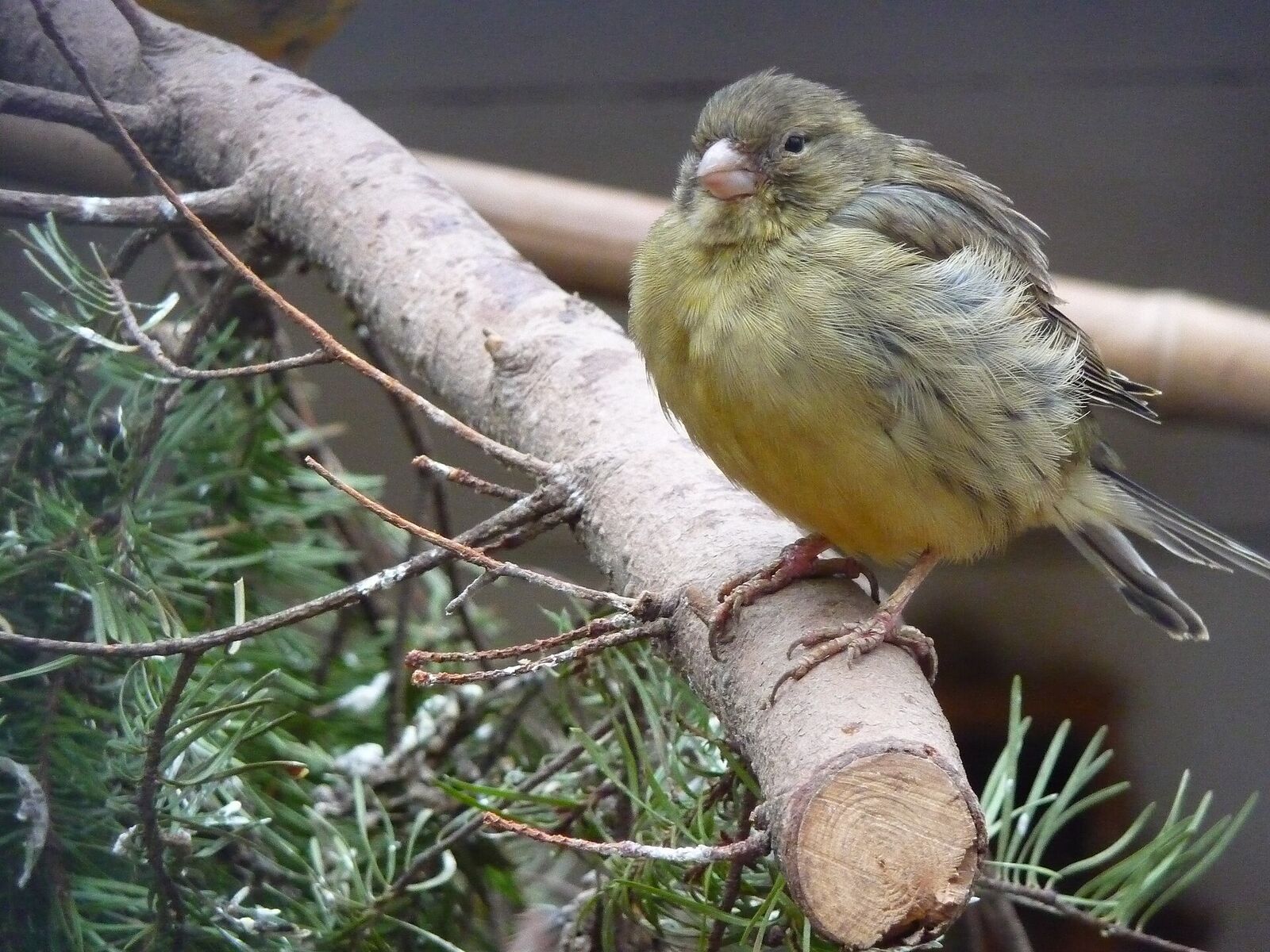
The yellow canary (Crithagra flaviventris) is a small passerine bird in the true finch family.
From Wikipedia: Yellow canary, CC BY-SA 4.0 (excerpt)

Care at a glance
Species-specific values
Values researched for this exact species. Air, surface and water temperatures are listed separately, and each source is kept as published rather than averaged.
| Minimum enclosure | For one newly acquired canary, the cage should be about 18 inches wide, 14 inches deep, and 18 inches high. Source: birdscoo.com | |
| Diet | About 60–70% of the diet should be specialized pellets; offer fresh fruits and vegetables and a moderate amount of fortified seeds. Source: birdscoo.com | |
| Feeding frequency | Fresh filtered, chlorine-free water must be provided and changed daily; fresh water and food should be available at all times. Source: birdscoo.com | |
| Social housing | Do not house male canaries together; keep a canary with at least one other canary in the room, in separate cages. Source: birdscoo.com | |
| Substrate | Line the droppings tray with habitat paper. Source: birdscoo.com |
Understanding the animal
About this animal
About this animal
It is a resident breeder in much of the western and central regions of southern Africa and has been introduced to Ascension and St Helena islands.
From Wikipedia: Yellow canary, CC BY-SA 4.0 (excerpt)
In the wild
In the wild
| Overview | The yellow canary (Crithagra flaviventris) is a small passerine bird in the true finch family. It is a resident breeder in much of the western and central regions of southern Africa and has been introduced to Ascension and St Helena islands. — From Wikipedia: Yellow canary, CC BY-SA 4.0 (excerpt) |
| Where it lives | Its habitat is karoo and coastal or mountain valley scrub. It builds a compact cup nest in a scrub. The yellow canary is a common and gregarious seedeater. — From Wikipedia: Yellow canary, CC BY-SA 4.0 (excerpt) |
| Appearance and size | The yellow canary is typically 10 cm in length. The adult male colour ranges from almost uniform yellow in the northwest of its range to streaked, olive backed birds in the southeast. The underparts, rump and tail sides are yellow. — From Wikipedia: Yellow canary, CC BY-SA 4.0 (excerpt) |
| History and naming | The yellow canary was formally described in 1789 by the German naturalist Johann Friedrich Gmelin in his revised and expanded edition of Carl Linnaeus's Systema Naturae. He placed it with the crossbills in the genus Loxia and coined the binomial name Loxia flaviventris. He specified the location as the Cape of Good Hope. — From Wikipedia: Yellow canary, CC BY-SA 4.0 (excerpt) |
Native climate (measured)
Native climate (measured)
| Warm-season highs | about 89°F (up to 95°F in the hottest sampled areas) |
| Cool-season lows | about 38°F (down to 30°F in the coldest sampled areas) |
| Average temperature | 59–72°F across sampled records |
| Relative humidity | 41–56% on average (driest month about 37%) |
| Rainfall | about 374 mm a year |
| Winters | Cool to cold winters (lows around 38°F) in much of its native range. Seasonal slowdown may be relevant, but species-specific biology determines whether brumation or hibernation occurs. |
Measured at 1325 wild occurrence records sampled against WorldClim 2.1 climate data (1970–2000 averages). Air conditions in the range are ecological context, not enclosure settings: microhabitats such as burrows, leaf litter or basking rocks can be cooler, warmer or more humid.
Profile
Profile
Researched for this exact species. Sources are listed under In the wild above.
History
The yellow canary was formally described in 1789 by the German naturalist Johann Friedrich Gmelin in his revised and expanded edition of Carl Linnaeus's Systema Naturae. He placed it with the crossbills in the genus Loxia and coined the binomial name Loxia flaviventris. He specified the location as the Cape of Good Hope.
From Wikipedia: Yellow canary, CC BY-SA 4.0 (excerpt)
Data and studies
The numbers
The numbers
Each bar is what one source reports. Where several sources weigh in, the dashed gold band marks their average.
Typical adult weight
Average adult body mass in each database (FishBase gives the maximum recorded weight).
Sources for this sheet
- Myhrvold et al. (2015). An amniote life-history database. Ecology 96: 3109 Peer-reviewed researchPeer-reviewed compilation of life-history data for over 21,000 birds, mammals and reptiles.
- 9 CFR 2.1: Animal Welfare Act licensing (USDA) Zoo, university or veterinaryWho needs a USDA license to breed, sell or exhibit animals.
- GBIF Backbone Taxonomy (Global Biodiversity Information Facility) (CC BY 4.0) Peer-reviewed researchInternational scientific taxonomy used here for classification. GBIF Secretariat (2023). GBIF Backbone Taxonomy. Checklist dataset https://doi.org/10.15468/39omei, accessed via GBIF.org.
- Wikipedia (species article) (CC BY-SA 4.0) Community referenceFree encyclopedia; useful overviews with their own citations. Short excerpts are quoted under CC BY-SA 4.0, each credited with a link to its article.
- The eBird/Clements Checklist of Birds of the World (Cornell Lab of Ornithology) Peer-reviewed researchThe standard global bird checklist maintained by the Cornell Lab of Ornithology; used here for complete species lists of widely kept bird families.
More finches and canaries
Domestic canary
Serinus canaria
Centuries of song in a small bird.
Pet trade

Black siskin
Spinus atratus
Aviary

Black-chinned siskin
Spinus barbatus
Aviary

Black-headed siskin
Spinus notatus
Aviary

Eurasian chaffinch
Fringilla coelebs
Zoos & aquariums

European goldfinch
Carduelis carduelis
Pet trade