
Home / Invertebrates / Ants and bees / California harvester ant
No federal permit to keepCalifornia harvester ant
Pogonomyrmex californicus
Invertebrates › Ants and bees (Hymenoptera) › Formicidae (Ants)
Experience: Easy
FamilyAnts
Kept byPet trade
Care at a glance
Species-specific values
Values researched for this exact species. Air, surface and water temperatures are listed separately, and each source is kept as published rather than averaged.
| Minimum enclosure | Provide a deep sand-filled nest area at least 10–15 cm deep. Source: antscout.com | |
| Humidity | Keep nest substrate moderately moist, with moderate humidity in the nest and drier conditions in the outworld. Source: antscout.com | |
| Diet | Offer a mix of small seeds, plus small insects; nectar or sugar water occasionally. Source: antscout.com | |
| Feeding frequency | Keep seeds available continuously and offer protein prey 2–3 times weekly. Source: antscout.com | |
| Social housing | Some California populations have multiple cooperating queens; Arizona populations are typically single-queen. Source: antscout.com | |
| Substrate | Use a deep sand substrate, optionally mixed with some clay for structure. Source: antscout.com |
Understanding the animal
In the wild
In the wild
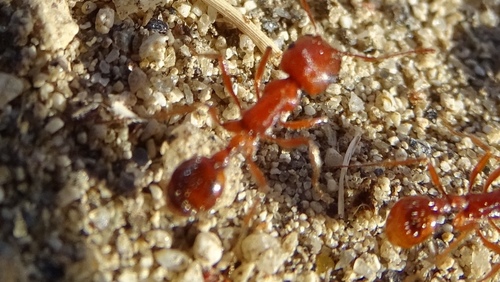
| Overview | Pogonomyrmex californicus, or the California harvester ant, is a species of ant in the subfamily Myrmicinae. It is native to North America, where it is found in the southwestern United States and northern Mexico. It is known as the ant species which is used by Uncle Milton's Ant Farm. — From Wikipedia: Pogonomyrmex californicus, CC BY-SA 4.0 (excerpt) |
| Biology | Pogonomyrmex californicus can be found in open, warm, and sandy areas. It typically forages during the day, both individually or in a group, forming columns as they work. It preys on arthropods, such as the larvae of the raisin moth (Cadra figulilella) and collects seeds. — From Wikipedia: Pogonomyrmex californicus, CC BY-SA 4.0 (excerpt) |
Sources for this sheet
- GBIF Backbone Taxonomy (Global Biodiversity Information Facility) (CC BY 4.0) Peer-reviewed researchInternational scientific taxonomy used here for classification. GBIF Secretariat (2023). GBIF Backbone Taxonomy. Checklist dataset https://doi.org/10.15468/39omei, accessed via GBIF.org.
- iNaturalist (captive observations) Community referenceCommunity observation platform run by the California Academy of Sciences and National Geographic; observations marked captive show animals living in homes, zoos and aquariums.
More ants

No federal permit
Black garden ant
Lasius niger
Pet trade
Easy

No federal permit
Florida carpenter ant
Camponotus floridanus
Pet trade
Easy
No federal permit
Honeypot ant
Myrmecocystus mexicanus
Pet trade
Easy

No federal permit
Leafcutter ant
Atta cephalotes
Pet trade
Easy

No federal permit
Mediterranean harvester ant
Messor barbarus
Pet trade
Easy

No federal permit
Pavement ant
Tetramorium immigrans
Pet trade
Easy