
Home / Invertebrates / Ants and bees / Red harvester ant
No federal permit to keepRed harvester ant
Pogonomyrmex barbatus
Invertebrates › Ants and bees (Hymenoptera) › Formicidae (Ants)
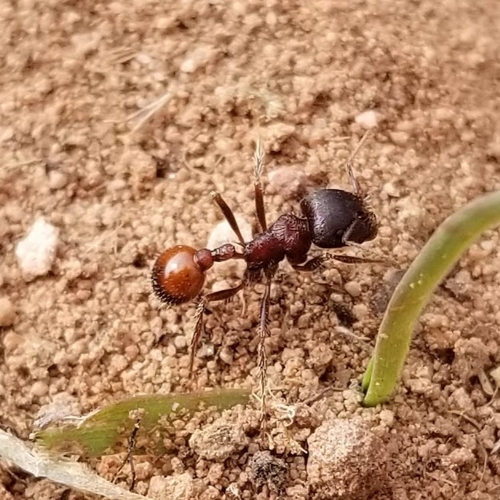
Pogonomyrmex barbatus is a species of harvester ant from the genus Pogonomyrmex.
From Wikipedia: Red harvester ant, CC BY-SA 4.0 (excerpt)
Care at a glance
Species-specific values
Values researched for this exact species. Air, surface and water temperatures are listed separately, and each source is kept as published rather than averaged.
| Nest temperature | 88–95 °F Source: statesideants.com | |
| Humidity | at least 90 % Source: statesideants.com | |
| Diet | Keep seeds available in the nest, and offer insect protein. Source: statesideants.com | |
| Feeding frequency | Offer protein at least every two weeks; offer it more often to encourage growth. Source: statesideants.com | |
| Social housing | House one queen per colony. Source: statesideants.com | |
| Seasonal cooling | Diapause is usually unnecessary; if desired, cool the colony to room temperature or slightly below for three to five weeks. Source: statesideants.com | |
| Minimum enclosure | Use sand or fine soil in the outworld because the ants cannot climb smooth surfaces. Source: ant-shack.com | |
| Outworld warm spot | 95 °F (35 °C) Source: ant-shack.com | |
| Diet | Offer a mix of seeds and crickets or mealworms for protein. Source: ant-shack.com | |
| Substrate | Use sand or fine soil in the outworld. Source: ant-shack.com | |
| Seasonal cooling | 59–64 °F (15–18 °C) Source: ant-shack.com |
Understanding the animal
About this animal
About this animal
Its common names include red ant and red harvester ant. These large (5 to 7 mm) ants prefer arid chaparral habitats and are native to the Southwestern United States.
From Wikipedia: Red harvester ant, CC BY-SA 4.0 (excerpt)
In the wild
In the wild
| Overview | Pogonomyrmex barbatus is a species of harvester ant from the genus Pogonomyrmex. Its common names include red ant and red harvester ant. These large (5 to 7 mm) ants prefer arid chaparral habitats and are native to the Southwestern United States. Nests are made underground (up to 2.5 m deep) in exposed areas. — From Wikipedia: Red harvester ant, CC BY-SA 4.0 (excerpt) |
| Wild diet | The main food source for red harvester ants usually consists of seeds, which they hoard in great numbers. The food is first ground to a bread-like consistency using the ants' large mandibles, and is then stored in a granary, assuring the colony access to food year-round. — From Wikipedia: Red harvester ant, CC BY-SA 4.0 (excerpt) |
Native climate (measured)
Native climate (measured)
| Warm-season highs | about 95°F (up to 97°F in the hottest sampled areas) |
| Cool-season lows | about 36°F (down to 30°F in the coldest sampled areas) |
| Average temperature | 62–72°F across sampled records |
| Relative humidity | 60–67% on average (driest month about 59%) |
| Rainfall | about 784 mm a year, spread fairly evenly |
| Winters | Cool to cold winters (lows around 36°F) in much of its native range. Seasonal slowdown may be relevant, but species-specific biology determines whether brumation or hibernation occurs. |
Measured at 134 wild occurrence records sampled against WorldClim 2.1 climate data (1970–2000 averages). Air conditions in the range are ecological context, not enclosure settings: microhabitats such as burrows, leaf litter or basking rocks can be cooler, warmer or more humid.
Sources for this sheet
- GBIF Backbone Taxonomy (Global Biodiversity Information Facility) (CC BY 4.0) Peer-reviewed researchInternational scientific taxonomy used here for classification. GBIF Secretariat (2023). GBIF Backbone Taxonomy. Checklist dataset https://doi.org/10.15468/39omei, accessed via GBIF.org.
- Wikipedia (species article) (CC BY-SA 4.0) Community referenceFree encyclopedia; useful overviews with their own citations. Short excerpts are quoted under CC BY-SA 4.0, each credited with a link to its article.
- iNaturalist (captive observations) Community referenceCommunity observation platform run by the California Academy of Sciences and National Geographic; observations marked captive show animals living in homes, zoos and aquariums.
More ants

Black garden ant
Lasius niger
Pet trade
California harvester ant
Pogonomyrmex californicus
Pet trade

Florida carpenter ant
Camponotus floridanus
Pet trade
Honeypot ant
Myrmecocystus mexicanus
Pet trade

Leafcutter ant
Atta cephalotes
Pet trade

Mediterranean harvester ant
Messor barbarus
Pet trade